Wednesday, December 8, 2010

Hindu Funeral Ceremony


The Hindu funeral ceremony, also known as Antyesti or Antim Sanskara, was a very important Sanskara, a sacrament in the Hindu society. This is the last sacrament in the Hindu life. There is not only one way to do this, but there are many different ways it can go depending on the life of the departed person such as the caste the person was in, the place they lived in, their social class, and their status. Although rites can differ, mostly all Hindus believe in the ritual of cremation, with the exception of infants that get buried.

People in the Hindu religion want to die in Varanasi, the holy city, but the trip there may not be affordable to the poorer families. However, if a family is able to do this, they will take this wonderful opportunity and have the funeral ceremony done there.

For the ceremony, the dead body is placed on a pyre made of wooden logs. The feet are placed facing southwards in order for it to be able to walk in the direction of the dead. The preist recites some funeral prayers and walks around the body three times. Once this is done, the pyre is set on fire and the body is left to burn.
As said in this video the Ganges river is how to make sure the soul of the dead person can reincarnate. However, if the body's remains are placed in the river in Varanasi, that is the way to moksha.

Varanasi

Varanasi

File:Ahilya Ghat by the Ganges, Varanasi.jpg

Mark Twain: "Varanasi is older than history, older than tradition, older even than legend, and looks twice as old as all of them put together.

-

-Basic Info

o On the banks of the Ganges river

o Holy city to Buddhists and Jains

o Holy place of Hinduism

- Basic Economy

o Several small cottage industries

o Banarasi Silk sari making, the production of textiles such as hand-woven carpets, and handicrafts.

- Basic Culture

o Houses are far from the Ghats

o Spacious; no pollution

- Holy City

o More than 1,000,000 pilgrims visit each year

- Importance of Varanasi

o Hindus believe that bathing in the Ganges remits sins and that dying in Kashi ensures release of a person's soul from the cycle of its transmigrations

o Varanasi is one of the holiest places in Buddhism too, being one of the four pilgrimage sites said to have been designated by Gautama Buddha himself

o It is believed to be the birthplace of Parshvanatha, the twenty-third Tirthankar

o There has been continuous tension between different religious communities in the city

- Varanasi Ghats

o Nearly 100 Ghats

o Many of the Ghats were built when the city was under Maratha control

o Most of the ghats are bathing ghats, while others are used as cremation sites

o Many ghats are associated with legends or mythologies while many ghats are privately owned

- Temples

o Every road crossing has a nearby temples

o Small temples form the base of daily local prayers and other rituals

o But there are many large temples too, stood up at different times through out the history of Varanasi

Khumb Mela


Khumb Mela is a huge pilgrimage celebrated every four years, in which Hindus gather at the Ganges River. This festival is celebrated at different places, depending on the position of the planet Jupiter, andthe sun.crowd.jpg

The major even of the festival is bathing at the banks of the river in whichever town it is being held. It is one of the biggest festivals celebrated in India.

When Jupiter and the sun are in the zodiac sign (Simha Rashi) it is held in Trimbakeshwar, Nashik; when the sun is in Aries it is celebrated at Haradwar; when Jupiter is in Taurus and the sun is in Capricorn Kumbha Mela is celebrated at Prayag; and Jupiter and the sun are in Scorpio the Mela is celebrated at Ujjain

kumbh-mela1.jpg


The other activities include religious discussions, devotional singing, mass feeding of holy men, women, and the poor. Khumb Mela is the most sacred of all pilgrimages.


The Sadhus are seen in saffron sheets with ash on them and powder on their skin, for the requirements of ancient traditions.


About 7 to 10 million people attend Khumb Mela


kumbh-mela-1998.jpg


The history of Khumb Mela is that there were gods who lost their strength and had to regain it. They needed Amritha ( Water of immortality). To get to the water they needed to make an agreement with their arch rivals the demons. However, the Khumb or urn containing the special water appeared and a fight broke out. It is believed that during the battle Lord Vishnu flew away with the Khumb and 4 drops landed in the places when Khumb Mela is celebrated, Prayag, Haridwar, Ujjain, and Noshik.


kumbh-mela-nasik.jpg 23sld1.jpg


Tuesday, December 7, 2010

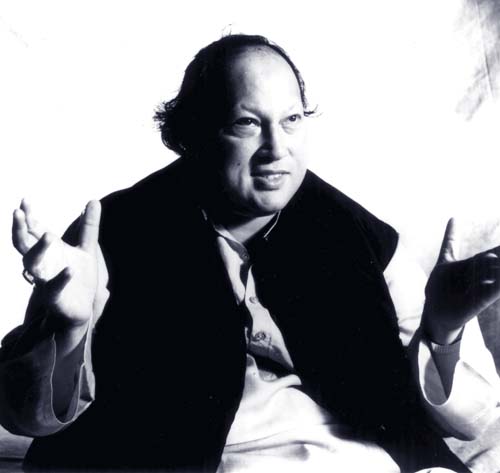
Nusrat Fateh Ali Khan - Qawwali Music


Nusrat Fateh Ali Khan was famous for Qawwali music, Islamic devotional music, in Pakistan. He was born in Faisalabad, Pakistan on October 13, 1948 and dies on August 16, 1997. Qawwali music has been in the family business for generations. His family has been preforming Qawwali music for over 600 years. In 1971, he became the leader of his Qawwali party after the death of his father. Forty days after the death of his father, he preformed his first performance called, "Chehlum." When he was leader of the party he preformed his first public performance called, "jashn-e-baharan." This was organized by the Radio Pakistan. Nusrat's first major hit was the song, "Haq Ali Ali."

This video is Nusrat singing "Haq Ali Ali:"


This video is one of the songs from Nusrat's album called Mustt Mustt:


Nusrat was awarded the "Legends" award at the UK Asian Music Awards. TIME Magazine lists him as the top 12 Artist and Thinkers in the last 60 years. A news magazine focusing on Asia wrote about Nusrat and said:
"He preformed Qawwali as nobody else of his generation did."


He preformed to Western audiences around the world including the US and Europe. Jeff Buckley, an American rock singer, said before he preformed a song:


"Nusrat, he's my Elvis."


Nusrat Fateh Ali Khan died on August 16, 1997 in a hospital in London, England of heart failure. Nusrat had a total of 125 albums throughout his career.


In 2005, People formed a group in NYC that preformed Nusrat's qawwali music.


Sitar Music


Sitar Music
By Jack L


The Sitar is an old Indian stringed instrument. It is very important to the Hindu religion, and unlike so many old instruments, it has made an appearance in modern music. It was developed in the 17th century, but it has been around in less complex states for a very long time. It is constructed using teak wood as a neck and gourd for its resonator, and it varied amount of strings. The stringcount varies from one Sitar to another, some have 17 and others have over 23. There are exceptions to this. It is a member of the lute family, and one plucks it to play it. To play it, one balances the Sitar between their left foot and right knee, while sitting cross legged. People think it evolved from a vina.

Some notable Sitar players:

Ravi Shankar - One of the most famous Sitar Players
famous_player_1.jpg
George Harrison - One of the Beatles, popularized Sitar music in the western world
imgres.jpg
Pandit Nikhil Banerjee -- Sitar Prodigy
famous_sitar_player_img3.jpg
Annapurna Devi - Renowned Sitar player and teacher, Ravi Shankar's wife
Annapurna_Devi_300.jpg


Videos:


http://www.youtube.com/watch?v=dKsZo-em7Es If you watch it, skip straight to 4:47 (Linked because it can't be embedded due to a request made by the person who posted the video.


Thanks for reading!

Data Ganj Baksh


Data Ganj Baksh is Pakistan's most important Sufi shrine. Sufism is a type of mystical dimension of Islamic beliefs and practices. Some of these Sufi shrines have been a target for aggression between Sufis and Islamic fundamentalists. Many Sufis come from far away to go to Data Ganj Baksh in Pakistan to give offerings to Allah at the shrine. One difference between Muslims and Sufis are that Muslims are on a path that will bring them close to God after a final judgment when they die.
Sufism beliefs the same but also believes that one can achieve divine presence on earth. Abul Hassan Ali Hujwiri or Data Ganj Baksh was a Sufi Muslim who spread Islam/Sufism through lots of parts of South Asia. He also was considered a saint and a scholar during the 11th Century. He spent almost all of his time visiting shrines and meditating before he finally became enlightened.

Holi

Holi is the festivals of colors and takes place during the spring. This festival was meant to welcome the spring, forget the colorless and cold winter, and bring blessings to the Gods for good harest and fertile lands. This festival takes place over a period of sixteen days. Before Holi there is always a bonfire to represent the escape of Parhlad when, Demoness Holika, carried him into a fire. Holika burnt, but Parnlad escaped the fire without any injuries. During Holi, people will squirt colorful powders and water at you covering you everywhere. They would say "Don't mind, it's Holi." People could get away with anything by saying that. They throw the colored powders and water at each other to represent the colors of spring.


This is the powder thrown on everyone during Holi


These are what the powders look like before being thrown


Water color instead of powder